
Definition, Benefits, and How to Set Targets Using SMART Goals to Improve Performance
Sep 11, 2026

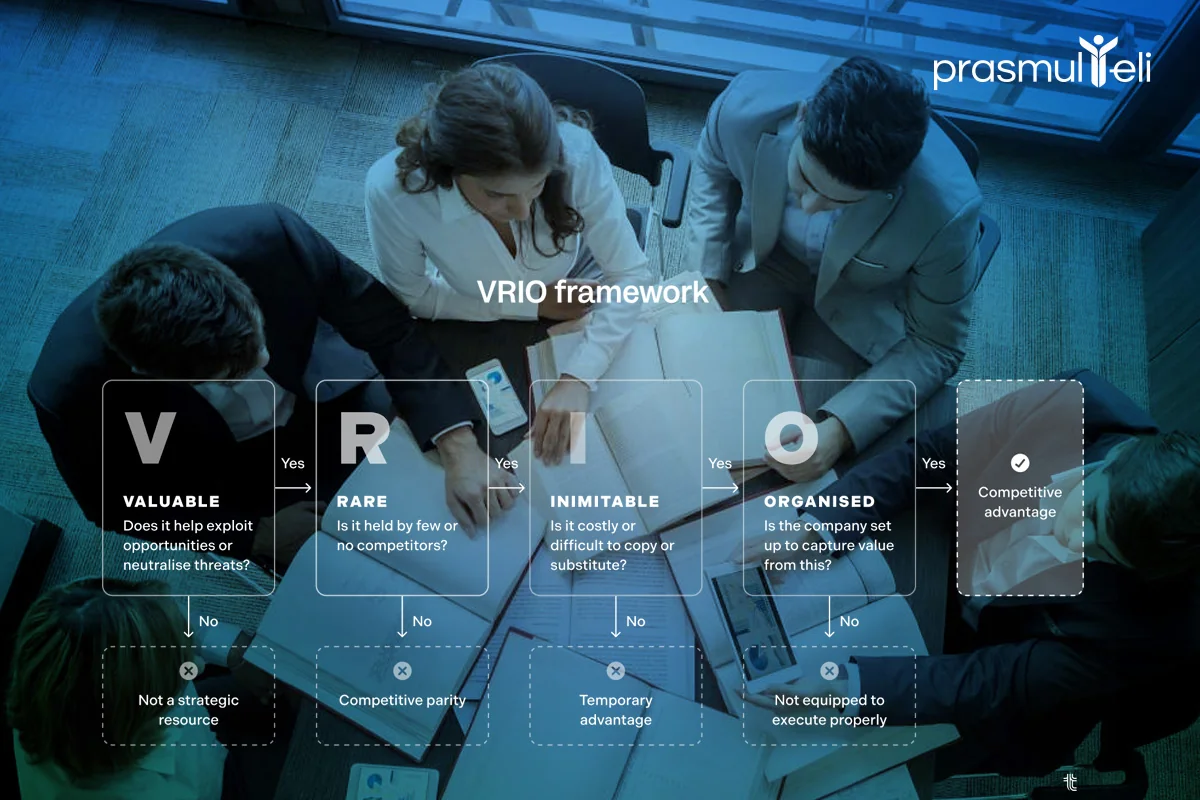
Understanding how to apply the VRIO framework helps organizations optimize their resources in order to compete sustainably. Business competition today is no longer determined solely by competitive pricing or product quality. Companies are also required to build a competitive advantage that is difficult for rivals to imitate. Amid technological development, the accelerating adoption of Artificial Intelligence (AI), and rapidly changing customer needs, organizations need to understand which resources and capabilities truly constitute their core strengths. Without this understanding, companies risk allocating investment to assets that fail to deliver long-term strategic value.
Many organizations have invested substantial funds in technology, product development, and business expansion. However, a considerable number have failed to achieve optimal results because they have not been able to identify the internal resources that genuinely create added value. In contrast, companies that succeed in maintaining their market position generally have the ability to recognize strategic assets, develop unique capabilities, and organize those resources into a sustainable advantage.
One analytical tool widely used in strategic management to address this challenge is the VRIO Framework. This framework helps companies evaluate whether their resources and capabilities meet four key characteristics: Valuable, Rare, Inimitable, and Organized. The results of this evaluation can serve as a basis for developing business strategy, determining investment priorities, and building differentiation that is difficult for competitors to replicate.
The VRIO concept was developed based on the Resource-Based View (RBV) theory introduced by Jay B. Barney. In his article Firm Resources and Sustained Competitive Advantage, Barney explains that sustained competitive advantage stems from a company's internal resources that are valuable, rare, difficult to imitate, and supported by an organization capable of exploiting them effectively.
Current developments in the business world further reinforce the importance of this approach. The Future of Jobs Report 2025 from the World Economic Forum indicates that companies must continue building organizational capabilities, developing workforce skills, and accelerating innovation in order to remain competitive amid rapid technological change. In other words, business advantage no longer stems solely from the ownership of physical assets, but also from a company's ability to manage its strategic resources.
This finding aligns with Microsoft's Work Trend Index 2025, which highlights that organizations that succeed in the age of AI are those able to combine technology with human capability, organizational knowledge, and an adaptive work culture. All of these elements are intangible resources that can become a source of competitive advantage when managed appropriately.
The importance of internal resources is also emphasized by Jay B. Barney, a leading academic and professor of strategic management at the David Eccles School of Business, University of Utah, said:
“Firm resources include all assets, capabilities, organizational processes, firm attributes, information, and knowledge controlled by a firm that enable it to conceive of and implement strategies that improve its efficiency and effectiveness.”
This statement shows that a company's resources are not limited to physical assets such as machinery or buildings. Knowledge, business processes, organizational culture, innovation capability, and employee competence are also strategic assets that can create a competitive advantage if they meet the VRIO criteria. Understanding how to apply the VRIO framework is therefore an important step for companies seeking to build sustainable competitiveness.
Through this article, you will learn the basic concept of the VRIO Framework, understand its benefits in business strategy analysis, and review examples of how the VRIO framework has been applied by companies, so that you can use it as a basis for developing more effective strategies.
When developing a business strategy, a company needs to understand whether its resources are truly capable of generating a competitive advantage. Not all assets or capabilities carry the same strategic value. Some resources can easily be imitated by competitors, while others can become a key differentiator in market competition. To identify this, companies can use the VRIO Framework as an analytical tool.
The VRIO Framework helps organizations evaluate whether a resource has the characteristics needed to create long-term competitive advantage. By using this approach, companies can determine which resources need to be maintained, developed, or given greater investment.
The VRIO Framework is a strategic analysis framework used to evaluate a company's resources and capabilities based on four main criteria: Valuable, Rare, Inimitable, and Organized. This framework helps companies determine whether a resource provides only a temporary advantage or is capable of creating a sustained competitive advantage.
According to Jay B. Barney, organizations that possess resources that are valuable, rare, difficult to imitate, and effectively organized have a greater opportunity to maintain their competitive position over the long term.
VRIO consists of four interrelated main elements.
These four elements must be satisfied progressively. If any one element is not met, the company's potential for competitive advantage is reduced.
The VRIO Framework derives from the Resource-Based View theory, which emphasizes that the source of competitive advantage comes from within the company, rather than solely from industry or market conditions.
This approach differs from strategies that focus only on external factors. RBV positions internal resources such as technology, organizational culture, employee competence, brand, patents, and business processes as the primary factors determining a company's long-term success.
VRIO and SWOT are both used in developing business strategy, but they have different areas of focus. SWOT comprehensively evaluates a company's strengths, weaknesses, opportunities, and threats, covering both internal and external factors.
VRIO, on the other hand, focuses specifically on evaluating a company's internal resources. For this reason, many organizations use VRIO to complement SWOT in order to make the strategic analysis process more comprehensive.
The VRIO Framework can be used when a company wants to develop a new strategy, undertake a business transformation, enter a new market, evaluate an investment, or identify the sources of competitive advantage it possesses.
This framework is also highly relevant in mergers and acquisitions, new product development, and digital transformation. By understanding which resources are truly strategic, companies can allocate investment more effectively and increase the likelihood of a successful business strategy.
In the next section, you will learn about the various benefits of the VRIO Framework for organizations, from helping identify competitive advantage and supporting strategic decision-making to improving a company's competitiveness amid increasingly dynamic business change.
In an increasingly competitive business environment, it is not enough for a company to simply understand market conditions and customer behavior. Organizations also need to know which resources genuinely constitute their internal advantage. This is where the VRIO Framework provides strategic value. By evaluating resources based on the Valuable, Rare, Inimitable, and Organized dimensions, companies can develop a more focused strategy while maximizing investment in the assets that deliver the greatest impact.
This approach not only helps organizations maintain their competitive position but also serves as a basis for long-term decision-making. When a company understands its unique capabilities, it can develop strategies that are difficult for competitors to imitate while being better prepared to face industry change.
According to Jay B. Barney, companies achieve sustained competitive advantage when they are able to leverage resources that are valuable, rare, and difficult to imitate, and that are supported by an organization capable of exploiting them optimally.
The primary benefit of the VRIO Framework is helping a company determine which resources truly set it apart from competitors. Not all assets carry the same strategic value. Some provide only a temporary advantage, while others are capable of creating sustained competitive advantage.
Through VRIO analysis, a company can evaluate a range of resources, from technology, brand, and patents to employee competence, organizational culture, and distribution networks. The results of this evaluation help management focus attention on the assets that contribute most to business success.
Sound strategic decisions must be grounded in an understanding of the company's internal conditions. VRIO helps management determine investment priorities, business development, and organizational transformation based on the strengths the company genuinely possesses.
For example, if a company has a superior and difficult-to-imitate Research and Development (R&D) team, it can prioritize investment in product innovation rather than competing through price wars. This approach produces a more sustainable strategy than one focused solely on short-term competition.
McKinsey & Company explains that companies that succeed over the long term are those that align their strategy with their core capabilities.
Not every company has unlimited resources. Management therefore needs to ensure that investment is directed toward assets that genuinely deliver strategic value.
VRIO helps organizations avoid wasting investment on resources that are easily imitated or that fail to provide a competitive advantage. Instead, companies can allocate their budgets toward developing capabilities with the potential to create long-term value.
Once a company knows which resources meet the VRIO criteria, it can determine investment priorities more objectively. For example, an organization may decide to enhance its technological capabilities, strengthen its brand, develop talent, or improve its operational systems based on the results of the analysis.
This approach helps companies achieve a better return on investment (ROI), since investment is directed toward areas that directly support business strategy. In addition, investment decisions become more measurable and better aligned with the company's long-term objectives.
The VRIO Framework not only helps maintain existing advantages but also encourages companies to keep innovating. When an organization understands the resources that constitute its core strengths, it can develop innovations that reinforce that competitive position.
For example, a technology company can leverage its research capabilities, customer data, or culture of innovation as a foundation for creating new products that are difficult for competitors to imitate. In this way, innovation is not pursued randomly, but is grounded in the capabilities the company genuinely possesses.
Sustained competitive advantage depends not only on having superior products or services, but also on a company's ability to maintain differentiation over time. VRIO helps organizations understand how internal resources can serve as the foundation for that advantage.
If a company's resources satisfy all the VRIO elements, competitors will find it difficult to imitate or replace them. As a result, the company has a greater opportunity to maintain its market share and deliver consistent performance over the long term.
In the era of digital transformation, many organizations are racing to adopt new technologies. However, technology alone does not necessarily constitute an advantage if it is accessible to every competitor.
Microsoft's Work Trend Index 2025 report shows that organizational advantage in the AI era stems from a combination of technology, organizational knowledge, a learning culture, and human resource capability. These factors are intangible assets that can be analyzed using the VRIO Framework.
The VRIO Framework helps companies align their resources with their business objectives. A strategy built this way considers not only market opportunities but also the organization's internal capacity to execute it.
This approach produces a more realistic strategy because it is grounded in the company's actual strengths. In addition, the organization becomes better prepared to face changes in the business environment, as it understands which resources need to be maintained, enhanced, or developed.
Having understood its benefits, the next step is to see how the VRIO framework is applied in practice. VRIO analysis is not used only by large corporations; it can also be applied by medium-sized organizations and growing businesses.
Through case studies, companies can see how each VRIO element is used to evaluate strategic resources, determine whether an asset is capable of creating a competitive advantage, and develop a strategy based on the results of that analysis.
The first step in applying the VRIO framework is to compile a list of all the resources and capabilities the organization possesses. These resources may include physical assets, technology, intellectual property rights, brand reputation, corporate culture, customer data, distribution networks, and human resource competencies.
This step is important because many companies focus only on visible assets, when in fact competitive advantage often stems from intangible assets such as knowledge, work processes, or innovation capability. The identification process therefore needs to be carried out comprehensively so that no strategic resource is overlooked.
Once all resources have been identified, evaluate them based on the following four key questions.
The answers to these four questions will indicate whether a resource provides only competitive parity, temporary competitive advantage, or sustained competitive advantage.
One of the most commonly used examples of VRIO framework application in strategic management education is the analysis of Apple.
For example, Apple's product ecosystem, which connects the iPhone, Mac, iPad, Apple Watch, AirPods, and various digital services, can be evaluated using VRIO as follows.
Valuable
Yes. The ecosystem provides an integrated user experience that increases customer loyalty.
Rare
Yes. Few companies possess an integration of hardware, software, and digital services as strong as Apple's.
Inimitable
Yes. The integration of technology, brand strength, R&D investment, and a large user base are difficult to replicate in a short period of time.
Organized
Yes. Apple has the organizational structure, culture of innovation, supply chain, and operational capability needed to make maximum use of these resources.
Because it satisfies all of the VRIO elements, Apple's ecosystem is a source of sustained competitive advantage.
Another example is NVIDIA, one of the leading players in the AI industry. NVIDIA's advantage stems not only from the GPUs it produces, but also from a combination of its CUDA technology, software ecosystem, research investment, relationships with developers, and reputation within the AI industry.
When analyzed using VRIO, this combination satisfies all four elements because it:
The results of a VRIO analysis help a company understand the strategic position of each resource it possesses.
In general, the interpretation is as follows:
This interpretation helps management determine which resources need to be maintained, developed, or even discontinued in terms of investment.
Although it may appear simple, many organizations still apply VRIO incorrectly.
Some of the most common mistakes include:
These mistakes can lead a company to set the wrong investment priorities or development strategy.
To obtain more accurate analytical results, a company should avoid using VRIO in isolation. Combine VRIO with other analytical tools such as SWOT, PESTEL, Porter's Five Forces, or Value Chain Analysis. This approach helps organizations gain a more comprehensive picture of both their internal and external conditions.
In addition, conduct the evaluation periodically, since a resource that is rare today may not remain rare in the years ahead. Changes in technology, regulation, and customer behavior can all affect the results of a VRIO analysis.
The greatest benefit of VRIO is realized when the results of the analysis become part of the company's strategy development process.
Organizations can use the evaluation results to determine investment priorities, develop core competencies, formulate differentiation strategies, and design digital transformation initiatives. In this way, strategic decisions are based not only on market opportunities, but also on the internal strengths the company genuinely possesses.
Ultimately, applying the VRIO framework helps companies understand that competitive advantage does not always stem from company size or the scale of investment. Sustained advantage is instead built through the ability to recognize, develop, and manage strategic resources that are valuable, rare, difficult to imitate, and supported by an organization capable of exploiting them optimally. Amid intensifying business competition and the rapid advance of AI, this approach helps organizations develop strategies that are more focused, adaptive, and oriented toward long-term growth.
The VRIO Framework is a strategic analysis tool used to evaluate whether a company's resources and capabilities are able to create a competitive advantage. It consists of four elements: Valuable, Rare, Inimitable, and Organized. The results of the analysis help a company determine which strategic strengths need to be maintained and developed.
The VRIO Framework helps a company identify the resources that provide competitive advantage, determine investment priorities, and support the development of long-term business strategy. It also helps organizations optimize the use of both tangible and intangible assets, resulting in more focused, capability-based business decisions.
SWOT analyzes a company's strengths, weaknesses, opportunities, and threats arising from both internal and external factors. VRIO, on the other hand, focuses on evaluating internal resources and capabilities to determine whether they are capable of creating a sustained competitive advantage. Because they have different areas of focus, the two frameworks are often used together.
The VRIO Framework can be applied by companies of various sizes, from small businesses and mid-sized companies to multinational corporations. It is useful when an organization wants to develop a new strategy, undertake a business transformation, evaluate an investment, or build a competitive advantage. Its application is also relevant to innovation and digital transformation processes.
Yes. In fact, VRIO has become even more important in the age of AI because it helps companies identify capabilities that are difficult to imitate, such as organizational knowledge, a culture of innovation, data, and human resource competence. Technology can be purchased by many companies, but the ability to integrate technology with business processes and organizational culture is an advantage that is far more difficult to replicate. VRIO therefore remains one of the relevant strategic analysis tools.
Sustained competitive advantage depends not only on the products or technology a company possesses, but also on the ability to understand and manage strategic resources effectively. By applying the VRIO Framework, you can identify assets that are genuinely valuable, determine investment priorities, and develop business strategies that are more adaptive to market change.
However, VRIO is only one of many analytical tools used in strategic management. To make more comprehensive business decisions, you also need to understand how to integrate VRIO with other frameworks such as SWOT, PESTEL, Porter's Five Forces, and Value Chain Analysis, so that the strategy you develop is genuinely aligned with the company's internal and external conditions.
If you want to master various strategic analysis tools and apply them in business decision-making, join the Strategic Business Analysis program from prasmul-eli. This program is designed to help professionals, managers, and business leaders sharpen their analytical skills, develop data-driven strategies, and create sustained competitive advantage for their organizations.



INSIGHT AND KNOWLEDGE
RECOMMENDATION ARTICLES