
Understanding the Definition, Components, and Calculation of Cost of Quality in Project Management
Nov 25, 2026


The success of a project is not determined solely by the quality of its final output or the timeliness of its completion. One of the most critical factors is an organization's ability to manage its budget effectively from the planning stage onward. Many projects experience delays, cost overruns, or even fail to achieve their objectives because the cost estimate prepared at the outset was inaccurate or failed to account for various risks that could arise.
In practice, preparing a cost estimate is not simply a matter of adding up all anticipated expenses. A project team needs to understand the scope of work, identify resource requirements, estimate activity durations, and consider external factors such as inflation, changes in material prices, and operational risk. Without a systematic approach, a company risks wasting its budget, which can affect overall profitability and project success.
To address this challenge, project management relies on various cost estimating techniques that help produce more objective and measurable budget forecasts. Techniques such as Analogous Estimating, Parametric Estimating, Bottom-up Estimating, and Three-point Estimating allow an organization to choose the approach best suited to its project's characteristics. With more accurate cost estimates, a company can make better decisions, control risk, and increase its chances of project success.
According to the Project Management Institute in A Guide to the Project Management Body of Knowledge (PMBOK® Guide) – Seventh Edition, cost estimating is an important part of the Project Cost Management process, which aims to develop an estimate of the resource costs needed to complete a project. A good estimate forms the basis for developing the cost baseline and serves as a reference for cost control throughout the project.
The importance of cost estimating is also emphasized by the Association for the Advancement of Cost Engineering (AACE International) through its Cost Estimate Classification System. This standard explains that the level of estimating accuracy is influenced by the completeness of project information. The more mature the project planning, the higher the level of accuracy that can be achieved in cost estimating.
Technological developments are also changing the way organizations perform cost estimating. The Pulse of the Profession report from the Project Management Institute shows that organizations with mature project management practices tend to have higher project success rates because they are better able to control scope, schedule, and cost.
In the age of AI, the estimating process is also increasingly supported by data analysis and automation. Microsoft's Work Trend Index 2025 explains that the use of AI helps organizations increase productivity through faster data analysis, more accurate planning, and better decision-making. This opens up opportunities for companies to prepare cost estimates supported by more comprehensive historical data and analytics.
One noted project management expert, Harold Kerzner, states that project management is planning, organizing, directing, and controlling company resources for a relatively short-term objective.
This statement affirms that resource management, including project budgeting, is an inseparable part of project management. Without an accurate cost estimate, an organization will struggle to control the use of resources, manage risk, and ensure that a project is completed in line with its established targets.
Through this article, you will learn the definition of cost estimating, understand the various cost estimating techniques commonly used in project management, and discover the steps for preparing an accurate cost estimate to support project success.
In every project, budget decisions must be made from the planning stage onward. Cost estimating provides the basis for an organization to determine funding requirements, allocate resources, and ensure that a project can be completed within the agreed scope. Cost estimating therefore functions not only as a budget forecast, but also as a decision-making tool that supports project success.
The cost estimating process involves analyzing various project components, such as labor, materials, equipment, technology, and indirect costs. The more complete the information available, the higher the level of accuracy that can be achieved in the estimate.
Cost estimating is the process of forecasting the amount of financial resources required to complete all activities within a project. This estimate is developed based on the scope of work, resource requirements, project duration, and various relevant assumptions.
In PMBOK®, cost estimating is one of the core processes within Project Cost Management, aimed at producing a cost forecast that can be used as the basis for developing a budget and controlling costs throughout the project.
Cost estimating serves several strategic purposes in project management.
With clear objectives, an organization can manage its resources more efficiently while increasing its chances of project success.
Cost estimating encompasses various components that directly or indirectly affect a project's budget.
Some of the main components include:
Identifying all of these components helps a company produce a more realistic estimate.
Cost estimating helps an organization understand the feasibility of a project before execution begins.
In addition, an accurate estimate makes it easier for a company to control its budget, manage scope changes, and minimize the risk of delays caused by insufficient funding. Without a good estimate, a project is more vulnerable to cost overruns and a decline in the quality of its results.
Cost estimating is closely related to scope management, schedule management, and risk management. A change in any one of these areas will almost always affect the project's budget. Cost estimating must therefore be developed in an integrated manner with the entire project planning process in order to produce a plan that is consistent and executable.
In the next section, you will learn about the various cost estimating techniques commonly used in project management, from Analogous Estimating, Parametric Estimating, Bottom-up Estimating, and Three-point Estimating to Expert Judgment. You will also learn about the strengths, limitations, and the conditions best suited to each technique.
Every project has different characteristics, levels of complexity, and resource requirements. There is therefore no single cost estimating method that can be applied to all types of projects. The choice of estimating technique must be tailored to the project's objectives, the availability of historical data, the level of uncertainty, and the current planning stage. By selecting the right technique, an organization can improve estimating accuracy while minimizing the risk of cost overruns.
In project management practice, several cost estimating techniques have become international standards and are recommended by the Project Management Institute through PMBOK®. Each technique has different strengths, limitations, and conditions of use, so it is important for a project manager to understand the characteristics of each before deciding which approach to use.
Analogous Estimating is a technique that uses data from similar past projects as the basis for forecasting the cost of a new project.
This technique is particularly useful when project information is still limited, such as during the initiation or feasibility study stage. Because it relies on historical data, the estimating process can be completed more quickly than with other methods. However, its level of accuracy is heavily influenced by how similar the characteristics of the previous project are to the project currently being planned.
Advantages:
Limitations:
Parametric Estimating uses the statistical relationship between a specific variable and project cost. Estimates are calculated based on measurable parameters, such as cost per square meter, cost per unit of product, cost per labor hour, or cost per kilometer.
For example, if constructing a building has an average cost of Rp8 million per square meter and the building area is 2,000 square meters, an initial project cost estimate can be calculated based on that parameter. This technique is suitable when an organization has consistent and reliable historical data.
Advantages:
Limitations:
Bottom-up Estimating is one of the most accurate cost estimating techniques.
In this method, each project activity is broken down into smaller tasks using a Work Breakdown Structure (WBS). The cost of each activity is then calculated separately before being summed into the total project budget.
Because it is carried out in detail, this technique takes more time, but it produces an estimate that is more comprehensive and accountable.
Advantages:
Limitations:
Uncertainty is an unavoidable part of every project. To reduce the risk of estimating errors, project management uses Three-point Estimating.
This method calculates an estimate based on three scenarios.
These three values are then used to produce a more realistic estimate, allowing an organization to account for risk from the planning stage onward.
This technique is especially useful for projects with a high level of uncertainty or when many external factors could affect cost.
In many projects, the experience of experts remains a highly valuable source of information.
Expert Judgment draws on the knowledge and professional experience of individuals who have handled similar projects in order to prepare a cost estimate. This approach is often combined with other techniques to produce a more accurate result.
According to PMBOK®, Expert Judgment is one of the important tools and techniques used across various project management processes because it helps reduce uncertainty when historical data is limited.
Technological developments mean organizations are increasingly using data analysis and AI to improve the accuracy of cost estimates.
AI systems can analyze thousands of data points from previous projects, identify cost patterns, predict the risk of budget overruns, and provide estimating recommendations based on current project conditions. This approach helps a company speed up the planning process while improving the quality of decision-making.
Microsoft's Work Trend Index 2025 report shows that AI is increasingly being used to support analytical work and data-driven decision-making, including in project planning activities.
The following provides a simple overview of the characteristics of each technique.
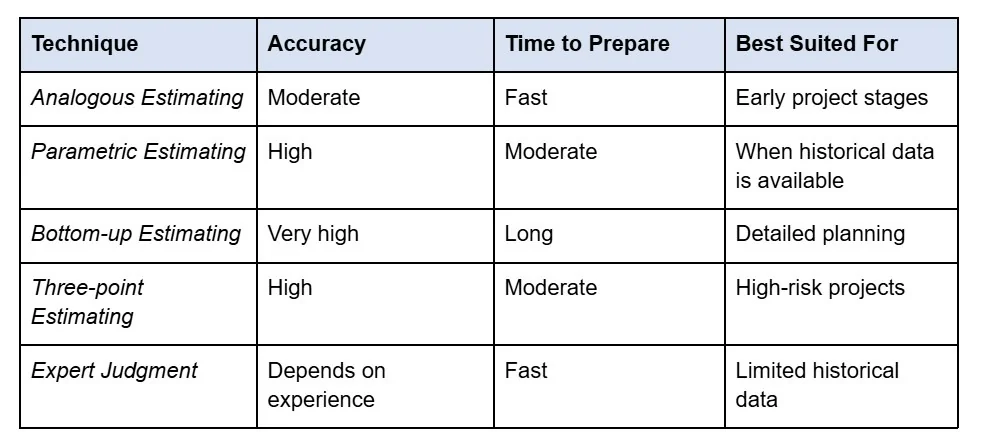
No single technique is always better than the others. Organizations often combine several methods to obtain a more accurate estimate suited to the characteristics of the project.
Beyond the choice of technique, the accuracy of a cost estimate is also influenced by various other factors.
Some of the main factors include:
The Association for the Advancement of Cost Engineering explains that the level of estimating accuracy increases as more information about a project becomes available. Cost estimates should therefore be updated periodically throughout the project life cycle.
Having understood the various cost estimating techniques, the next step is to learn how to apply them within the project planning process. A good estimate depends not only on the method used, but also on the process of identifying scope, resource requirements, budget preparation, and periodic evaluation of project changes.
In the following section, you will learn the steps for preparing a cost estimate in project management, from determining the project scope and identifying activities, to selecting the appropriate estimating technique, developing the budget, conducting validation, and monitoring and updating the estimate so that it remains relevant throughout project execution.
The first step is to clearly define the project scope. An organization needs to understand the project's objectives, the deliverables to be achieved, the boundaries of the work, assumptions, and success criteria.
The more detailed the project scope, the easier it is for the team to identify all activities that will incur costs. Conversely, an unclear scope is often the main cause of cost overruns (scope creep), as additional work that was not previously accounted for tends to emerge.
Once the scope has been determined, break the project down into smaller activities using a Work Breakdown Structure (WBS).
Each activity needs to be documented in detail so that labor, material, equipment, technology, and third-party service requirements can be properly identified. This step forms the basis for the cost estimating process when using the Bottom-up Estimating method.
Each activity requires different resources. Identify all project needs, such as:
The more complete the identification of resources, the lower the likelihood of unexpected costs arising during project execution.
Once all activities and resource requirements are known, select the cost estimating technique best suited to the situation.
For example:
In practice, organizations often combine several techniques to obtain a more accurate estimate.
According to the Project Management Institute, selecting an estimating technique should take into account the characteristics of the project, the quality of the available data, and the maturity of the planning process.
Once the cost estimate for each activity has been completed, the next step is to develop the overall project budget.
This budget includes:
A comprehensive budget helps a company control project cash flow while preparing funds to address risks that may arise.
Before the budget is used as the basis for project execution, carry out a validation process.
Validation can be conducted through:
This process helps ensure that the cost estimate aligns with market conditions and the project's characteristics.
The Association for the Advancement of Cost Engineering emphasizes the importance of the validation process, as a good estimate must be supported by adequate information and an accountable methodology.
Cost estimating does not stop once a project begins.
Throughout project execution, a company needs to compare actual costs against the budget that has been developed. If changes occur in scope, material prices, or schedule, the cost estimate needs to be updated so that it continues to reflect the project's actual conditions.
This approach helps an organization take corrective action before a significant cost overrun occurs.
Technological developments allow organizations to prepare cost estimates more quickly and accurately.
Project management software, data analysis tools, and AI can help process historical data, predict resource requirements, identify potential cost risks, and generate simulations of various budget scenarios.
According to Microsoft's Work Trend Index 2025, AI is playing an increasingly important role in supporting analytical work and data-driven decision-making, including in project planning activities.
Ultimately, cost estimating technique is one of the important foundations of successful project management. By understanding the project scope, identifying all activities, selecting an appropriate estimating method, developing a comprehensive budget, and conducting periodic monitoring, an organization can reduce the risk of cost overruns while increasing its chances of project success. Amid the development of technology and AI, the cost estimating process is also becoming increasingly accurate, supported by faster and more comprehensive data analysis.
Cost estimating is the process of forecasting the budget required to complete all activities within a project. This estimate forms the basis for budget preparation and cost control throughout the project. With an accurate estimate, an organization can reduce the risk of cost overruns and increase its chances of project success.
Some commonly used cost estimating techniques include Analogous Estimating, Parametric Estimating, Bottom-up Estimating, Three-point Estimating, and Expert Judgment. Each technique has different strengths and levels of accuracy suited to different project conditions. The choice of method depends on data availability, project complexity, and the planning stage.
Cost estimating helps an organization develop a realistic budget, allocate resources efficiently, and control spending during project execution. It also forms the basis for investment decision-making and risk management. Without a good estimate, a project is more prone to delays and budget overruns.
The accuracy of a cost estimate is affected by the clarity of the project scope, the quality of historical data, the experience of the project team, the complexity of the work, price changes, and external risks. The more complete the available information, the higher the level of accuracy that can be achieved. Cost estimates should therefore be updated periodically throughout the project.
AI helps an organization analyze historical data, predict resource requirements, identify cost risks, and produce faster, data-driven estimates. This technology also supports the simulation of various scenarios, making decision-making more accurate. However, AI-generated results still need to be validated by project managers and subject matter experts to ensure they align with the context of the project being carried out.
The ability to prepare an accurate cost estimate is one of the essential skills in project management. By understanding various cost estimating techniques and applying them correctly, an organization can develop a more realistic budget, control the risk of cost overruns, and increase its chances of project success from the planning stage through completion.
However, project success does not depend on cost estimating alone. A project manager also needs to master other aspects, such as scope management, scheduling, risk management, communication, team leadership, and quality control. Mastering these competencies helps an organization execute projects more effectively, efficiently, and in alignment with business objectives.
If you want to deepen your project management skills comprehensively, join the The Real Project Management program from prasmul-eli. This program is designed to help professionals, supervisors, and managers understand best practices in project planning, execution, monitoring, and control, enabling them to deliver projects on time, within budget, and with maximum value for the organization.


INSIGHT AND KNOWLEDGE
RECOMMENDATION ARTICLES