
How to Evaluate Investments Using the Time Value of Money in Business Decision-Making
Jul 15, 2026

Financial statements are not merely administrative documents prepared for shareholders or regulators. They are strategic information sources that help management understand financial condition, evaluate business performance, and plan future action.
However, financial statements only become valuable when they are interpreted properly. Without the right analytical method, financial figures can remain difficult to understand and fail to generate useful insight. Two of the most widely used approaches are vertical analysis and horizontal analysis.
Vertical analysis compares each item in a financial statement with a base item from the same period. In an income statement, each line is often compared with total revenue. In a balance sheet, items are usually compared with total assets.
This method helps management see the proportion of each element within the financial statement. It reveals, for example, the percentage of operating expenses relative to revenue or the share of liabilities relative to total assets.
Vertical analysis is useful for assessing operating efficiency and for benchmarking against industry structures. It helps managers understand how financial resources are allocated and whether the cost or asset structure appears healthy.
Horizontal analysis compares financial data across multiple periods. Its main objective is to identify growth patterns or declines in financial performance over time.
Using this method, management can compare this year's financial results with prior years and measure the changes in value or percentage terms. This helps reveal whether revenue is growing, whether costs are increasing disproportionately, and whether financial performance is improving or weakening.
Horizontal analysis is especially important for evaluating the impact of business strategy over time and for helping investors and stakeholders understand the direction of the company.
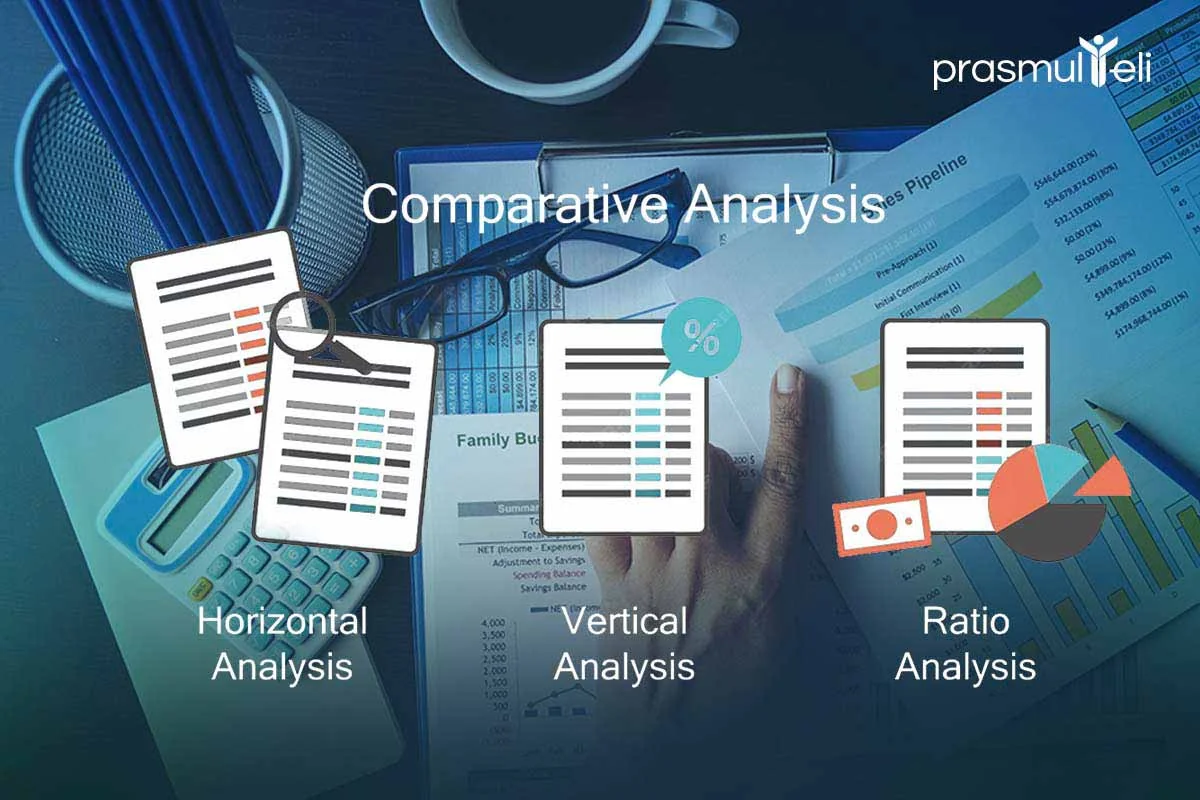
Vertical analysis focuses on financial structure within a single period. It explains how each component contributes to the total at that point in time.
Horizontal analysis focuses on change across time. It helps the company understand growth patterns, movement in key accounts, and longer term development.
Vertical analysis is commonly used to evaluate cost structure and operating efficiency. Horizontal analysis is more often used to assess business growth and the financial impact of strategic decisions over time.
Vertical analysis produces structural insight. It shows where resources are concentrated and how the company is allocating them.
Horizontal analysis produces trend insight. It helps management understand whether performance is moving in the right direction and how quickly change is happening.
The ability to analyze financial statements is essential not only for finance teams, but also for operational managers and business leaders. Sound analysis helps organizations understand performance, identify financial risks, and plan growth more effectively.
When vertical and horizontal analysis are used together, they provide a more complete picture. Management can see both the financial structure of the business today and the trend of its development over time.
Understanding the difference between vertical and horizontal analysis is an important step toward better decision making. Vertical analysis helps explain financial structure in one period, while horizontal analysis reveals movement and growth across periods.
By combining both methods, companies gain a more comprehensive understanding of financial condition and business direction. To develop this capability further, prasmul-eli offers the Financial Analysis program for professionals and organizations seeking stronger, data-based financial decision making.



INSIGHT AND KNOWLEDGE
RECOMMENDATION ARTICLES


